
Objective of the study
This study aims to assess the CREA project’s initiatives in promoting locally led adaptation strategies and gender-responsive climate actions while also identifying opportunities for integrating women into the renewable energy sector. The specific objectives of the study are:
- To assess the relevance and effectiveness of the CREA project concerning LLA principles;
- To judge the project’s initiatives in promoting climate-smart livelihoods and the effectiveness of the IGA revolving fund in accessing finance by the communities, especially women living in remote climate-vulnerable areas;
- To assess gender perspectives in promoting LLA principles and climate-smart livelihoods;
- To examine the extent of women’s access to renewable energy, barriers that exist, and potential opportunities to engage women in the renewable energy sector;
- To investigate the relevance of the project to national policies;
- To pinpoint gaps and come up with recommendations;
- To suggest an institutional mechanism for promoting LLA.
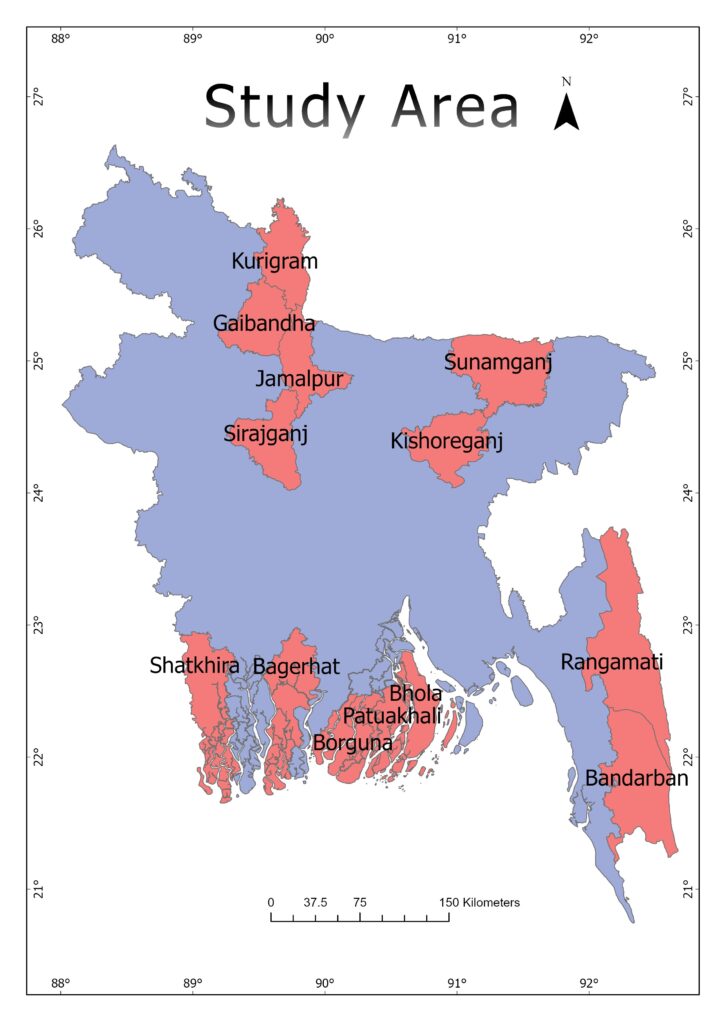
Study area
The study will be conducted in 13 districts of climate-vulnerable coastal, floodplain/char, haor, and hill tracts areas.
Scope of the study
- The study will explore the effectiveness of the project aligned with LLA principles.
- The study will explore the effectiveness and relevance of the project alignment with the gender-responsive LLA principles.
- The study will explore livelihood resilience initiatives and the effectiveness of revolving funds in accessing IGA and finance by the project beneficiaries.
- The study will assess gender-responsiveness in LLA and climate-smart livelihoods contributions.
- The study will examine the extent of women’s access to renewable energy, barriers that exist, and potential opportunities to engage women in the renewable energy sector.
- The study will investigate the relevance of the project to national policies;
- To study will find the gaps and recommend actions for gender-responsive LLA promotion, climate-smart livelihood promotion, and women’s access to renewables.
- The study will develop an institutional mechanism for promoting LLA in the project areas, considering intersectional climate vulnerability.
Methodology of the study
Desk review
The study will also review national, regional, and international locally-led adaptation principles, guidelines, and implemented projects documents that include Bangladesh: Local Government Initiative on Climate Change (LoGIC), UNDP’s Climate Change Resilience Project (CCRP), Community-Based Wetland Project, Coping with Climate Risks by Empowering Women in Coastal Areas, Piloting Climate-Resilient Development Initiatives Strengthening Community Resilience in the Southwestern Coastal Area, Promoting Diversified Agro-Based Activities in the Jamalpur District, CARE’s Ecosystem-based Adaptation (EbA), Climate Bridge Fund; Global:Huairou Commission’s Community Resilience Funds, Pawanka Fund, Slum Dwellers International’s Urban Poor, LoCAL mechanism; Asia-Pacific:Local Adaptation Plans of Action (LAPA) in Nepal, Micronesia Conservation Trust (MCT), Mahatma Gandhi National Rural Employment Guarantee Scheme (MGNREGS) in India, Swayam Shikshan Prayog (SSP) in India, YAKKUM Emergency Unit (YEU) in Indonesia, Shramik Bharti in India, etc.
Primary data collection
Both qualitative and quantitative data from the study locations will be collected through Household Surveys (HHS), Focus Group Discussions (FGDs), and Key Informant Interviews (KIIs). The HHS will be developed during the inception phase and will be included in the inception report for approval. Apart from conducting HHS, relevant participatory tools (such as FGDs and KIIs) will be used to capture the perspectives of different stakeholders from the local level to the national level using predefined checklists and guidance notes. The Analysis of data from secondary sources will be triangulated with primary data. Primary information (qualitative and quantitative) and other relevant information will be collected and analyzed following the interactive steps:
- Participatory research to get actual data, perspectives, and experientialknowledge of the project beneficiaries on climate change impact, adaptation, LLA, energy access, IGA, and livelihoods activities of the project, etc., through Household Survey (HHS), Focus Group Discussion (FGD)
- Participatory capacity analysis of institutionsto understand skills, understanding, capacity, gaps, and challenges of gender-responsive LLA, livelihood resilience, energy supply and demand, green energy transition, etc, through key Informant Interviews.
- Assessment of project activities through LLA lens.
- Assessment of project activities through a gender-responsive LLA lens.
- Climate-smart and sustainable livelihood value chain analysis
- Location-specific value chain cost-benefit analysis
- Gender, Equality, Diversity, and Inclusion(GEDI) Analysis
- Renewable energy feasibility assessment
- LLA institutional framework development
Funded By